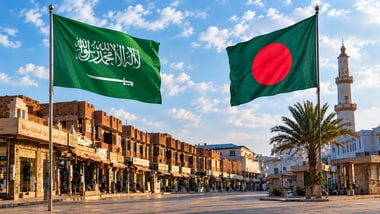
On 14 October 2026, the Kingdom of Saudi Arabia executed two Bangladeshi nationals, Nazrul Islam Abdul Basir and Siti (Sweety) Akhtar, in the Makkah Region. They had been convicted of an “immoral act” inside a mosque and sentenced to death as a discretionary (ta’zir) punishment. Bangladesh’s consular mission appears not to have been told of their arrest, their trial or their execution. Nothing has been made public about the charges, the evidence or their defence.
On 26 October 2026, members of the British Bangladeshi diaspora protested outside the Embassy of Saudi Arabia in London. Oxford Matrix provided pro bono technical support to the organisers. We prepared the formal memorandum of protest and demands that they submitted to the Embassy, and advised on the legal framework behind it.
The memorandum
The memorandum sets out where the Kingdom fell short of its obligations under the Vienna Convention on Consular Relations and the Arab Charter on Human Rights. It also challenges the use of the death penalty for a non-lethal offence. Its message is simple: migrant rights are human rights, and a person does not lose the protection of the law by crossing a border for work.
It makes six demands of the Government of Saudi Arabia:
1. Make public the charges, the nature of the defence, the trial record, the judgment, the appeal decision and the Royal Order confirming the sentences.
2. Publish all communication with Bangladesh’s Embassy and Consulate, and state whether and when each detainee was told of the right to consular access.
3. Commission and publish an independent review of the arrest, investigation, prosecution, sentencing and consular handling of the case, and hold to account any officials who failed in their duties.
4. Audit and make public all cases of Bangladeshi nationals detained, on trial or under sentence in Saudi Arabia, including those facing the death penalty.
5. Set out publicly the protection available to migrant workers, including legal aid, interpretation, complaint mechanisms, consular access and compensation.
6. Disclose all complaints of abuse of Bangladeshi migrant workers received over the past ten years, and how each was resolved.
The Saudi authorities have been given 30 days to respond in writing.
Taking it further
A protest is a starting point. In the days that followed, we helped the organisers carry their concerns to the governments and international bodies with the power to act. Letters, each with the memorandum attached, went to:
- The Ambassador of Saudi Arabia in London, asking that the memorandum be sent to Riyadh.
- The High Commission of Bangladesh in London, urging the Government of Bangladesh to seek the case record, support the families, and protect its nationals detained in the Gulf.
- The UK Foreign, Commonwealth & Development Office, asking the Minister for the Middle East and North Africa to raise the case with the Saudi authorities, in line with the UK’s opposition to the death penalty in all circumstances.
- Four UN human rights mandate holders: the Special Rapporteurs on extrajudicial, summary or arbitrary executions; on the independence of judges and lawyers; and on the human rights of migrants; and the Working Group on discrimination against women and girls.
Each UN letter was tailored to that mandate. Together they invite a joint communication to Saudi Arabia. They also ask the UN to engage the Government of Bangladesh on its own duty to protect its workers abroad.
Building alliances
No single organisation can protect migrant workers alone. We have reached out to Saudi human rights organisations and to migrant rights groups working across the Middle East and North Africa. Our aim is to share information, document cases and coordinate advocacy, so that the next worker detained in the Gulf does not face trial alone and unseen.
To migrant workers and their families
If you or a family member has been detained, put on trial, abused or denied your rights while working abroad, we want to hear from you. We offer pro bono support and advice to migrant workers and their families. This includes help documenting what happened, raising cases with consular authorities and UN human rights mechanisms, and connecting you with local lawyers and support groups.
Everything you share with us is treated in confidence. Contact us at contact@oxfordmatrix.org.
To governments of migrant-sending countries
Millions of workers from South and Southeast Asia and Africa sustain the economies of the Gulf, and the remittances they send home sustain their own countries. Yet too often their governments learn of an arrest, a trial or an execution only after it is over.
Oxford Matrix would welcome the opportunity to advise governments of migrant-sending countries, and their ministries and overseas missions, on building their own capacity to protect workers abroad. We would be glad to help them:
- Respond quickly: set up rapid-response procedures so missions learn of arrests early and act at once.
- Monitor cases: track detained and convicted nationals, and ensure each receives consular and legal support.
- Train officials: prepare consular and labour attachés on international law, fair-trial standards and case handling.
- Prepare workers before departure: brief workers on their rights, what to expect abroad and where to seek help.
- Shape policy and diplomacy: advise on bilateral agreements, diplomatic strategy and engagement with UN and regional human rights mechanisms.
Our aim would be to leave governments with lasting systems of their own, not a dependence on outside help.
To discuss how we can support your government, contact us at contact@oxfordmatrix.org.