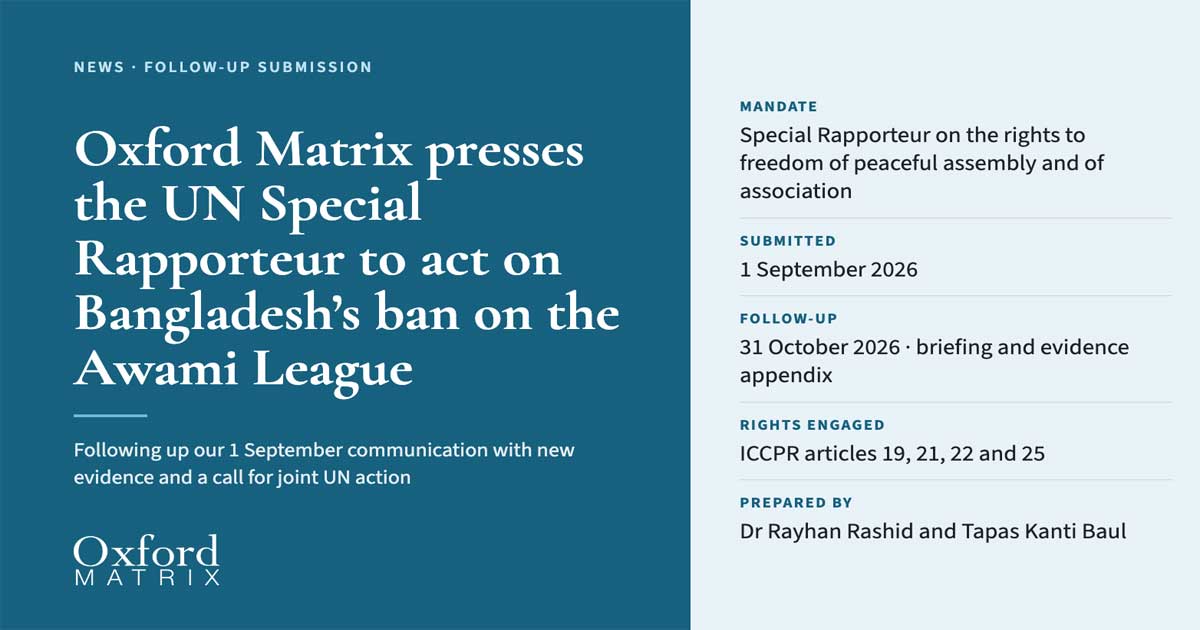
Oxford Matrix has submitted a communication to the United Nations Special Rapporteur on the rights to freedom of peaceful assembly and of association, Ms Gina Romero. It challenges the continuing ban on the Bangladesh Awami League, and was followed this week by a further submission with new evidence and legal analysis.
The communication was submitted on 1 September 2026 on behalf of the Bangladesh Awami League, through the President and General Secretary of the German Awami League. It sets out how the ban was imposed in May 2025 by the interim government of Dr Muhammad Yunus under Bangladesh’s anti-terrorism law. The decision was taken by the executive, without notice to the party, a hearing or any court order. It was made permanent legislation in April 2026 by a Parliament elected in February 2026 without the Awami League’s participation, and the current government of Tarique Rahman has maintained it.
The ban prohibits all activities of the party and its affiliated organisations: meetings, rallies, press statements and online publicity. The communication documents its consequences: the party’s inability to hold its council or elect its leadership, mass cases and arrests of members, and the absence of any route to challenge the ban in Bangladesh’s courts.
The submissions stress that the ban reaches far beyond the party’s leadership. In the four elections held under neutral caretaker governments between 1991 and 2008, the Awami League won between 30% and 48% of the national vote. Measured against today’s 127.7 million voters, its supporters and voters number in the tens of millions, and all of them are affected. Because any gathering or publicity in the party’s support is prohibited, members cannot protest peacefully against arrests and attacks, or raise funds for their legal defence. Lawyers associated with the party have themselves been jailed and assaulted in court. Journalists, academics and talk-show commentators have been charged under the Anti-Terrorism Act for views seen as sympathetic to the party.
A distinctive feature of the communication is its focus on the ban’s effect beyond Bangladesh’s borders. The petitioners are dual German-Bangladeshi nationals who lead the party’s affiliate in Germany. The communication explains how activity that is lawful in Germany — organising, campaigning and speaking for the party — risks being treated in Bangladesh as support for a proscribed organisation. That exposes members abroad, and their families and property in Bangladesh, to legal and practical consequences. The resulting chilling effect, it argues, is itself an interference with freedom of association and expression.
This follow-up submission reports developments since September, including the in absentia death sentences handed down to the party’s General Secretary Obaidul Quader and six other senior leaders on 15 September — including Joint General Secretary AFM Bahauddin Nasim, former state minister Mohammad Ali Arafat and the heads of the party’s youth and student wings — and to Joint General Secretary Mahbubul Alam Hanif on 29 October. It notes that the Government of Bangladesh has not published any reply to a joint letter sent by three UN mandate holders in December 2025 (AL BGD 6/2025). Instead, the ban was entrenched in legislation.
That silence matters. On 29 December 2025, three UN mandate holders — the Special Rapporteur on counter-terrorism and human rights, Ben Saul; the Working Group on Arbitrary Detention; and the Special Rapporteur on the independence of judges and lawyers, Margaret Satterthwaite — wrote jointly to the Government of Bangladesh (AL BGD 6/2025). They warned that banning the party under counter-terrorism powers may amount to an unnecessary and disproportionate interference with freedom of association, assembly, expression and political participation. They asked the Government to explain what concrete threat justified a party-wide ban, how long it would last, whether the party had been given notice or a hearing, and how voters would keep a genuine choice at the February 2026 election. More than ten months later, no reply has been published.
The submissions argue that the ban violates articles 19, 21, 22 and 25 of the International Covenant on Civil and Political Rights, drawing on the jurisprudence of the UN Human Rights Committee and the European Court of Human Rights on the dissolution of political parties. They ask the Special Rapporteur to take up the matter with the Government of Bangladesh, jointly with other UN mandates.
follow-up also draws on the Special Rapporteur’s own work. In her 2024 report to the UN General Assembly, Protecting the rights to freedom of peaceful assembly and of association from stigmatization (A/79/263, paras. 11 and 32), Ms Romero warned that broad anti-terrorism laws are being used to stigmatise and silence people who exercise their rights of assembly and association. The submissions show that this is precisely what has happened in Bangladesh, where an anti-terrorism law has been used to ban one of the country’s two largest political parties and to prosecute those seen as its supporters.
The communication was prepared and sent by Dr Rayhan Rashid and Barrister Tapas Kanti Baul of Oxford Matrix.
About this work
Oxford Matrix is a strategic advisory firm working on international criminal law, transitional justice, human rights and governance. It prepares submissions to United Nations human rights mechanisms, including the Special Procedures, and advises governments, organisations and individuals on accountability processes and cross-border legal strategy. Its recent work has included advocacy before UN Special Rapporteurs on the execution of Bangladeshi migrant workers abroad.
To discuss our work with UN mechanisms, email contact@oxfordmatrix.org